FPGA-Based Implementation and Comparative Analysis of Robinson and Kirsch Compass Edge Detectors
DOI:
https://doi.org/10.31838/JVCS/07.02.12Keywords:
VHDL, Digital design, Edge detector, Robinson edge detector, Kirsch edge detectorAbstract
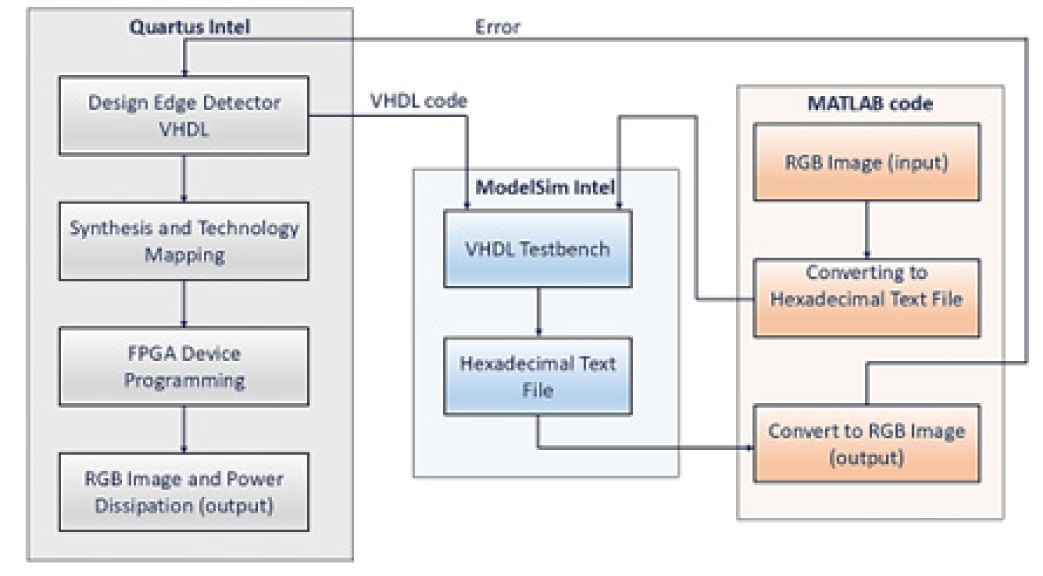
This approach aims to develop and implement the Robinson and Kirsch compass edge detector on various CMOS technologies, such as Field-Programmable Gate Arrays (FPGAs), which are well-suited for digital implementation. In digital image processing, edge detection is a technique used to find edge pixels in an image; these edges form the boundaries of objects. The edge detection system is described using hardware description language (HDL) at an abstract level, and the digital circuits for the Robinson and Kirsch compass edge detector are implemented at a lower (hardware) level. At this hardware level, physical devices are used to obtain real results. The input for the digital system is an RGB color image, which is converted to grayscale, followed by the application of edge detectors and a threshold. ModelSim Intel is used to simulate and verify the functionality of the digital system, while Intel Quartus Prime is used to implement the edge detectors on different CMOS technologies, including Cyclone IV, Cyclone V, and Cyclone LP 10 FPGA devices. Additionally, a comparative analysis based on the CMOS technologies used is conducted, considering accuracy and edge thickness, digital design complexity, resource usage, and power dissipation. The results indicate that the Kirsch edge detector is appropriate for accurate applications and is capable of detecting weak edges. The Kirsch edge detector, on the other hand, dissipates more power because it is higher in cost and computational complexity. Furthermore, the CMOS technology used affects the overall power dissipation of the digital design as well as the digital design requirements.