Privacy-Preserving Access Control for IoT Smart Homes Using Hyperledger Fabric Consortium Blockchain and Edge Computing on Raspberry Pi
DOI:
https://doi.org/10.31838/JCVS/07.02.05Keywords:
VLSI Security, Blockchain Accelerator, Hyperledger Fabric, PUF, Smart Home IOT, Edge Computing, Access ControlAbstract
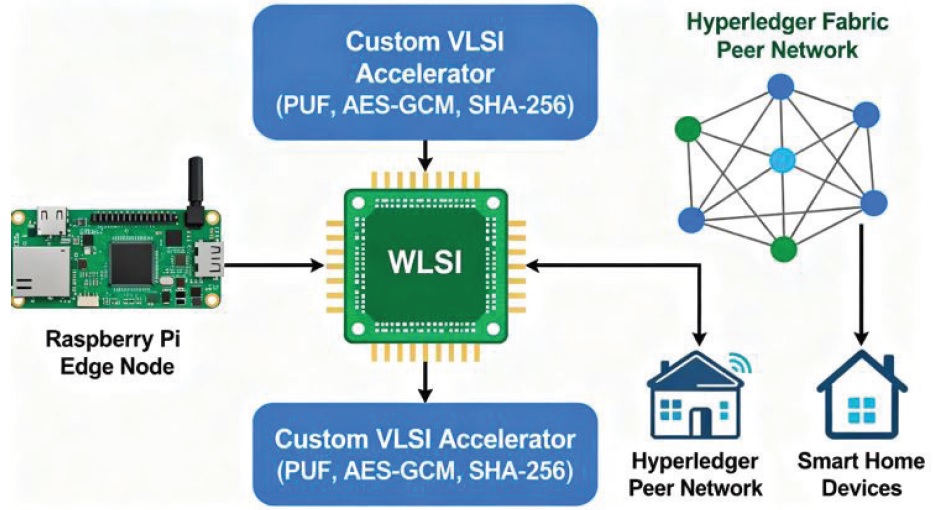
The problem of privacy and security continues to be a challenge in smart home Internet of Things (IoT) environments, in which heterogeneous devices share sensitive information and execute autonomous behaviours. The paper offers a privacy-protecting access control architecture implemented using hardware acceleration (Raspberry Pi gateway) by means of Hyperledger Fabric consortium blockchain and a VLSI-based edge security unit implemented on a Raspberry Pi gateway. The proposed co-design, unlike the traditional cloud-based authentication, includes the low-power cryptographic accelerator, a secure identity engine designed in Physical Unclonable Function (PUF) and a hardware access-control pipeline synthesized with the 65 nm CMOS technology. These hardware components enhance blockchain-intensive functions such as SHA-256 hashing, AES-GCM encryption, certificate verification, and policy analysis and minimise processing overhead that is commonly linked to blockchain-based IoT systems. The Hyperledger Fabric offers tamper-evident, decentralized access registration, and Raspberry Pi links with the custom accelerator through a hybrid software-hardware software flow of execution. Experimental testing shows that it has lower authentication latency, throughput efficiency and energy consumption compared to pure software-based blockchain validation. The hardware accelerator has a maximum of 61% lessening in transaction validation jolt and 47 percent power decrease when cryptographic tasks are performed. It improves privacy in that both the identity of the user, the control commands and the records of authorization are stored and authenticated using hardware bound cryptographic primitives and a distributed register. Hardware acceleration, blockchain consensus, and edge intelligence can ensure a high-quality solution to smart home access control, which is scalable.
Published
How to Cite
Issue
Section